More Than Fireworks
Diwali is one of the world's most widely observed festivals — but to describe it as a single tradition is to misunderstand its extraordinary cultural depth. The festival is celebrated by Hindus, Jains, Sikhs, and some Buddhists, each community observing it for different historical and spiritual reasons that have almost nothing to do with one another at the theological level, yet converge in the shared symbol of light. This plurality — the same flame meaning different things to different people — is itself one of Diwali's most important characteristics. It is a festival that accommodates multitude.
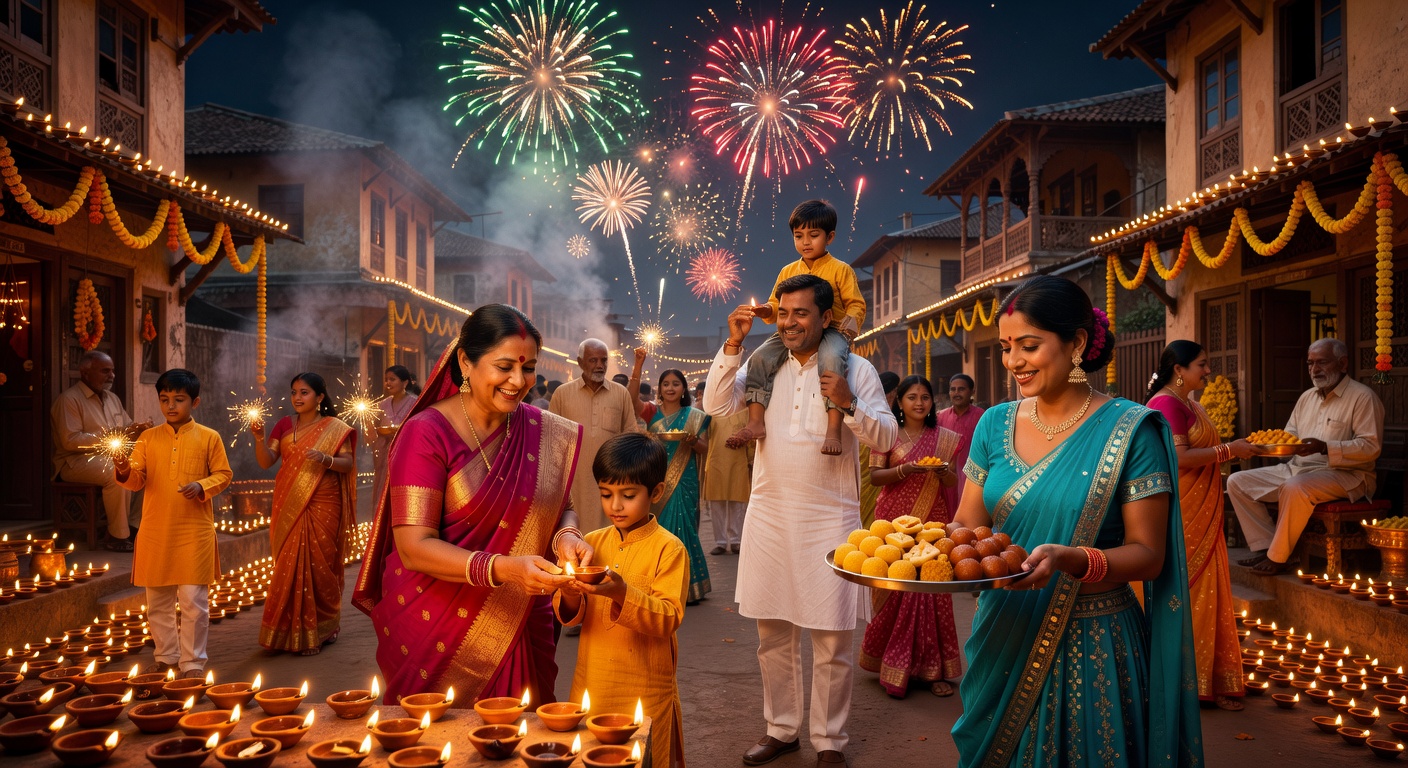
For the majority of Hindus, Diwali celebrates the return of Lord Rama to his kingdom of Ayodhya after 14 years of exile and the defeat of the demon king Ravana. The people of Ayodhya — fearing their king would not find his way home in the darkness — lit thousands of small clay oil lamps along every path and rooftop. The gesture of lighting a lamp to guide someone home through darkness is so simple and so universal that it requires no translation. It is the gesture of Diwali, endlessly repeated across India and the diaspora, in clay dishes and electric lights, on windowsills and temple steps, on the surface of sacred rivers and across apartment balconies in London and Toronto.
Diwali unfolds across five days, each with its own name, mythology, and ritual. The sequence begins with Dhanteras — a day of prosperity worship and the purchase of gold or silver — and concludes with Bhai Dooj, a celebration of the bond between brothers and sisters. The central night — Lakshmi Puja, the third day — is the festival's apex: the night of the new moon, when darkness is at its deepest and the need for light at its greatest. On this night, Lakshmi, the goddess of prosperity and beauty, is believed to visit every home that has been cleaned, decorated, and illuminated in her honour.
As India's diaspora has spread across every continent, Diwali has become a genuinely global festival — celebrated in Trafalgar Square in London, at the White House in Washington, D.C., in the streets of Little India in Singapore and Durban. For diaspora communities far from India, Diwali carries an additional weight: it is a festival of cultural memory, a way of passing language, story, and identity from one generation to the next in contexts that offer few other vehicles for that transmission. The flame of a diya lit in a Leicester living room is not only for Lakshmi; it is for continuity.