When Tea Becomes Philosophy
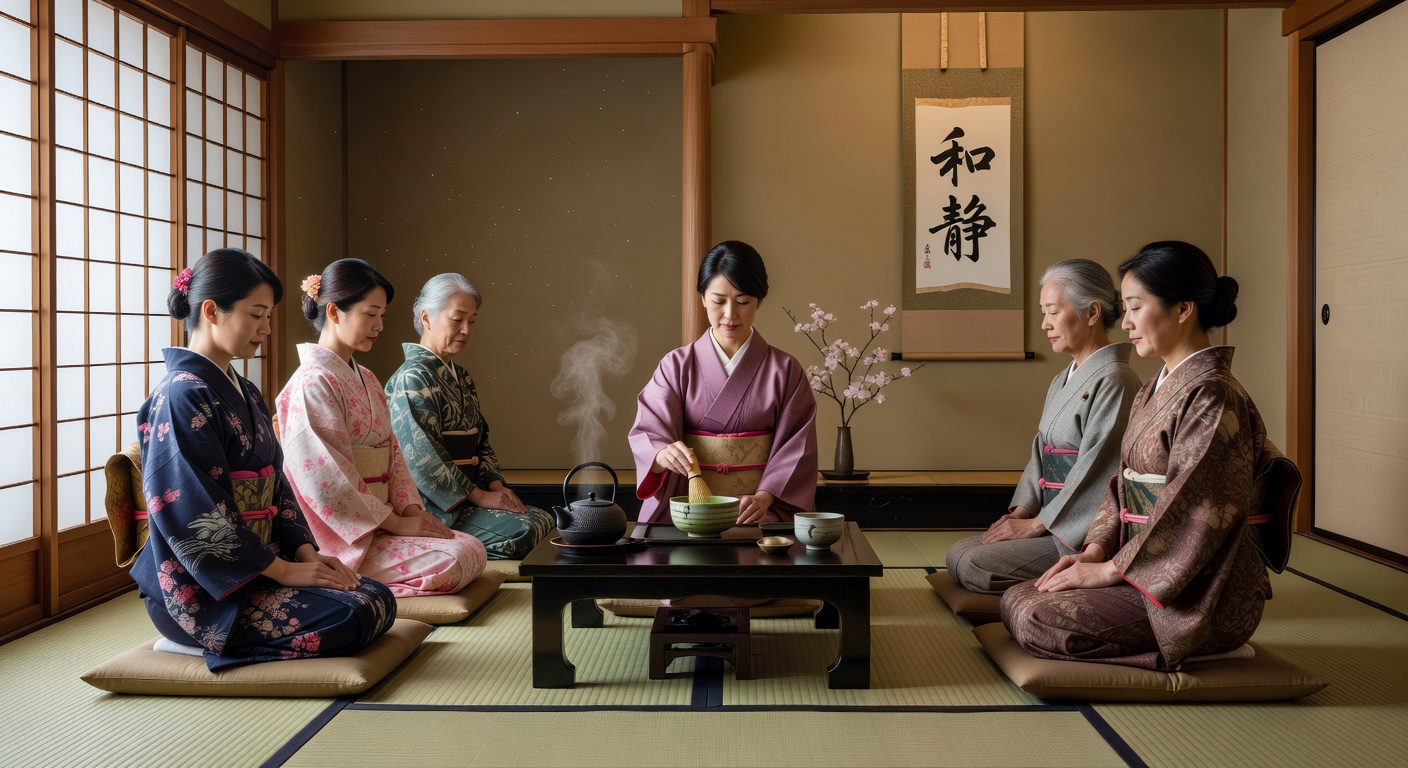
At the heart of chanoyu — the Japanese "Way of Tea" — lie four principles articulated by the great 16th-century tea master Sen no Rikyū: wa (harmony), kei (respect), sei (purity), and jaku (tranquility). These are not decorative concepts applied to an existing ritual; they are the structural logic of every element of the ceremony — the arrangement of utensils, the architecture of the tea room, the sequence of movements, the quality of silence between host and guests. Rikyū did not invent the tea ceremony, but he distilled it to its philosophical and aesthetic essence, establishing a framework that has governed chanoyu practice for 500 years.
The architecture of the traditional tea room is itself a philosophical statement. The nijiriguchi — a small crawl-through entrance approximately 66 centimetres square — requires every guest, regardless of social rank or status, to bow in order to enter. The samurai must remove his sword; the feudal lord must crouch as the farmer crouches. Inside the tea room, the social hierarchies of Japanese feudal society are temporarily dissolved. This spatial democracy — enforced by a door so small that pride cannot fit through it — was a radical act in Rikyū's era and remains a quietly powerful one today.
The choreography of chanoyu is total. Every movement of the tea practitioner — the way the chakin (linen cloth) is folded, the arc of the ladle as it lifts water from the iron kettle, the angle at which the tea bowl is rotated before being offered to a guest — is precisely prescribed and requires years of study to perform with unconscious naturalness. The utensils themselves are objects of deep aesthetic consideration: the rough-textured tea bowl, the hand-carved bamboo whisk, the lacquered tea caddy — each is a work of art in a tradition that erases the boundary between craft and fine art, between the functional and the beautiful.
Central to chanoyu is the concept of ichi-go ichi-e — "one time, one meeting." The phrase, also attributed to Rikyū, instructs both host and guest to treat every tea gathering as a once-in-a-lifetime encounter, never to be repeated in exactly this way. The light through the shoji screens will fall differently tomorrow; this particular combination of people, season, and moment is unrepeatable. Chanoyu teaches presence through impermanence — a lesson embedded not in words but in the precise weight of a bowl of green tea held in both hands.