Japan's Ancient Capital of Culture
For over a millennium, from 794 to 1869, Kyoto served as the imperial capital of Japan. It was here that the emperor held court, that the great religious schools took root, and that the refined aesthetic sensibility known as miyabi — courtly elegance — became the defining character of Japanese civilization. No other city in Japan bears such a concentrated weight of history and meaning.
Within Kyoto's boundaries stand more than 1,600 Buddhist temples and 400 Shinto shrines, including 17 UNESCO World Heritage Sites. From the golden pavilion of Kinkaku-ji to the stone garden of Ryoan-ji, these are not merely tourist attractions — they are living religious institutions, maintained by communities of monks and priests who have continued their practices for centuries without interruption.
Remarkably, Kyoto survived the Second World War largely intact. While other Japanese cities were devastated by bombing, Kyoto was spared — a decision that has allowed it to remain the living museum of Japanese culture. Walking through Gion or Higashiyama today, one encounters an urban fabric that has changed little since the Edo period, a rare gift to the world's collective heritage.
Thousands of vermillion torii gates form a serpentine tunnel winding up the forested slopes of Mount Inari. Dedicated to the Shinto god of rice and prosperity, Fushimi Inari is one of Japan's most photographed sites — yet its power is equally felt at 2 a.m. as at noon, when pilgrims walk in near silence through the gate corridors, each donated by a business or family seeking divine favour.
In the cobblestoned lanes of Gion and along the narrow canal street of Pontocho, the hanamachi — "flower districts" — preserve one of Japan's most storied living traditions. Geiko (Kyoto's term for geisha) and their apprentice maiko spend years mastering classical dance, music, tea ceremony, and the art of conversation. Glimpsing a maiko gliding between engagements at dusk remains one of Kyoto's most memorable encounters.
West of the city centre, the towering bamboo of Arashiyama creates a cathedral of green light and rustling sound. Adjacent to the grove, Tenryu-ji — a Zen temple with a 700-year-old garden — exemplifies the Japanese art of borrowed scenery, framing the surrounding mountains as part of the composition. On the Oi River below, traditional boatmen in woven hats pole visitors through quiet channels lined with maples and plum trees.
Cherry blossoms transform Maruyama Park and the Philosopher's Path into corridors of pale pink. Crowds gather beneath Kyoto's famed sakura trees for hanami (flower viewing) picnics — a tradition unchanged for a thousand years.
July brings the Gion Matsuri, Kyoto's grandest festival — a month of events culminating in the spectacular Yamaboko Junko parade of towering, tapestry-hung floats. Summer evenings along the Hozu River offer firefly viewing, a magical counterpart to the heat.
Koyo — the crimson and gold of autumn foliage — rivals spring sakura for sheer beauty. Eikan-do temple holds night illuminations where maple leaves glow red above still reflecting ponds. The season is Kyoto at its most painterly.
Snow settles on the golden pavilion of Kinkaku-ji in a scene of breathtaking stillness. New Year brings the ringing of temple bells across the city — 108 strikes at each temple, one for each human desire, releasing the congregation into the new year.
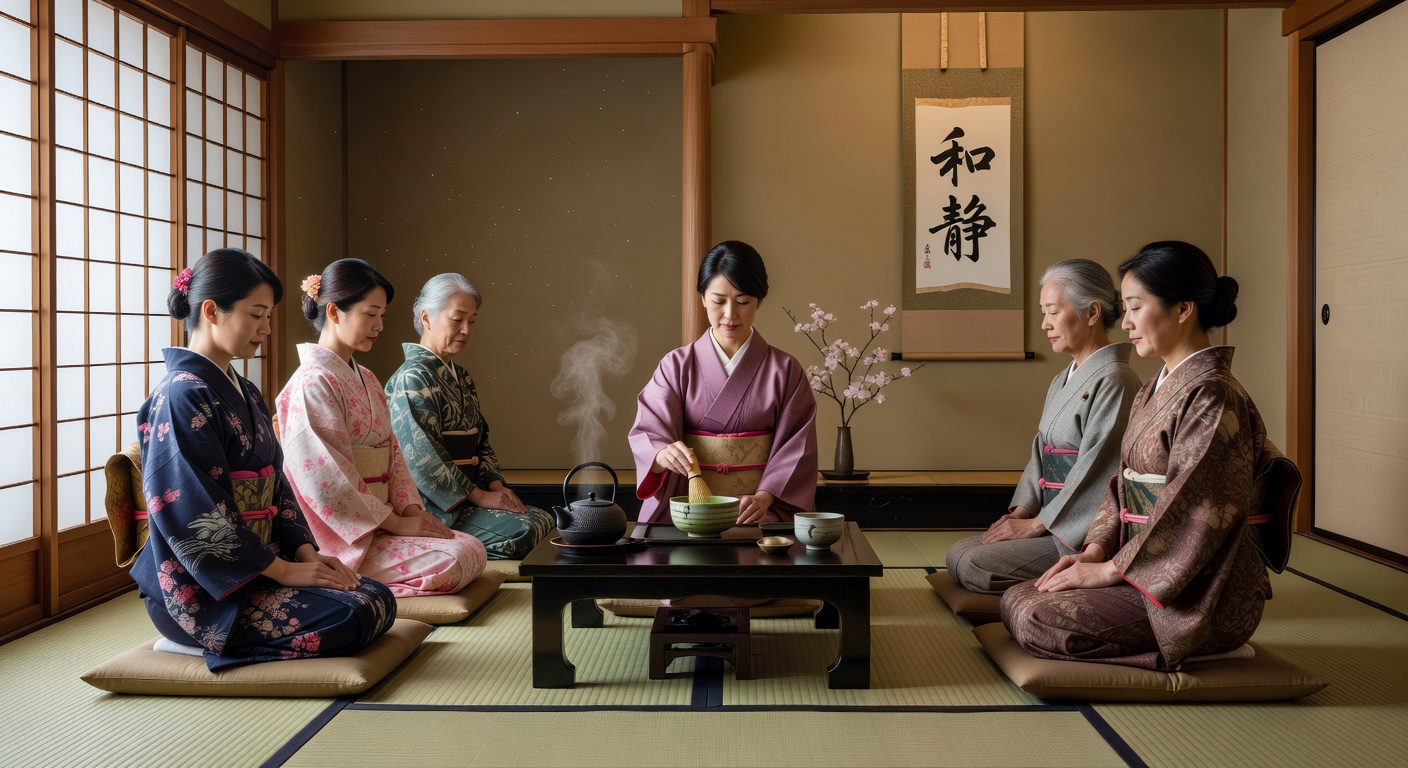
Kyoto offers rare opportunities to step inside living ritual rather than merely observe it. Tea ceremony workshops — from introductory 45-minute sessions to full chaji experiences lasting four hours — are available throughout the city, led by licensed practitioners in authentic tea rooms.
Zazen meditation sessions open to visitors are held at several Zen temples, including Kennin-ji and Shunkoin. Sitting in silence in a centuries-old tatami room, guided by a monk, offers an encounter with the Japanese concept of mu — emptiness — that no guidebook can prepare you for.
Kodo, the Way of Incense, is perhaps the least-known of Kyoto's traditional arts. Practitioners learn to "listen" to fragrant wood as it smoulders — a meditative practice that has been refined in Kyoto's temples and aristocratic households since the Heian period.
Explore the Tea CeremonyKyoto is connected to Osaka (15 min) and Tokyo (2h15 by Shinkansen bullet train) via the JR network. Kansai International Airport serves international arrivals, with easy onward rail connections. Within Kyoto, the city bus network and subway cover all major sights efficiently.
Stay in Higashiyama for immediate access to historic streets and temples. Gion offers the geisha district atmosphere. For a quieter, more residential experience, Fushimi in the south provides a local rhythm away from the tourist centres, with the famous Inari shrine on your doorstep.
Remove shoes before entering temples and private spaces. Do not photograph geiko or maiko without permission — they are professionals at work, not costumes. Speak quietly in sacred spaces. When visiting active religious sites, be respectful of ongoing ceremonies. Tipping is not practised in Japan.
From the philosophy of wabi-sabi to the precision of the tea ceremony, Japan offers an inexhaustible depth of cultural inquiry.
Explore Japanese Culture